Monday, 4 December 2017

Arg Pied For 2nd Time & Lies To His Back-Up Date?! | Celebs Go Dating


Arg gets pied for a 2nd time, lies to his back-up date and gets really nervous about the food! Watch the series on All 4:

Washington women may have found a blueprint for the season in blowout vs. Portland

featured imageConsistency has been virtually nonexistent for the Washington women’s basketball team, which has alternated wins and losses all season. First-year coach Jody Wynn has changed the starting lineup in six of seven games, including Sunday’s 93-67 nonconference victory over Portland.
The 26-point blowout — the most lopsided win of the season for the Huskies (4-3) who won consecutive games for the first time this season — proved to be a blueprint of the schemes Wynn is trying to implement. http://dcsmostfabulous.com
Washington’s trapping defense collected nine steals and forced 26 turnovers, which led to 29 points.
The Huskies had more rebounds (43-29), assists (25-13), points in the paint (46-34) and points off the bench (50-27) than the Pilots. A school-record seven UW players scored in double figures while everyone who played logged a minimum of 11 minutes and finished with at least two points in a season-high scoring display for the Huskies. “We tell them that on any given night it could be somebody else,” Wynn said. “Somebody could be our leading scorer. We don’t really talk about who’s scoring and who’s not.
“But to have seven players in double figures and to share the ball as well as we did tonight and play unselfishly. We could have had kids take shots, but they made that extra pass wide open to another teammate and that’s beautiful basketball.” The Huskies have made considerable progress since a season-opening 79-59 defeat against Idaho State. Their only other losses have been against No. 2 Texas and No. 9 Ohio State. Wynn, who sometimes substitutes five players at a time, relies on a balanced offensive attack in which five players have led Washington in scoring this season. Amber Melgoza (14 points) and Mai-Loni Henson (14 points and 10 rebounds) led the way Sunday in front of 1,410 at Alaska Airlines. But the sum was far greater than the parts for UW, which received 12 points from Kierra Collier, Alexis Griggsby and Missy Peterson. Jenna Moser added 11 points, seven assists and six rebounds while Khayla Rooks finished with 10 points.
“It’s just being ready at all times,” Henson said. “It could change every night. Some person could be feeling the hot hand at any given point. We’re going to be there for each other and rely on each other.” Washington dashed out to a 22-16 lead after the first period and were ahead 39-29 at halftime.
The Huskies put the game away in the third period when they outscored the Pilots 32-19. Washington sank 6 of 9 three-pointers in the period, including two each from Griggsby and Rooks. “It was close at halftime, but when we came out we knew that we needed to work a little harder and be a little better,” Melgoza said. “We needed to do the extra things and we did. We were more poised.”
Washington led 39-33 with 9:03 left in the third and went up by 25 points (68-43) before taking a 71-48 lead into the fourth. Portland (3-4), which received 18 points from guard Darian Slaga, never got closer than 21 points the rest of the way. Washington converted 12 of 33 three-pointers and shot 49.4 percent from the floor. The Huskies travel to Boise State on Thursday, and they have four games remaining before their Dec. 29 Pac-12 opener at defending regular-season champion Oregon State. “I don’t expect us to blow through the next few games,” Wynn said. “Every game is a different story. Every game presents its different and unique challenges, but I’m really happy with the unselfish style of basketball that we’re playing.

3D Printing In Luxury Fashion: Revolution Or Evolution?

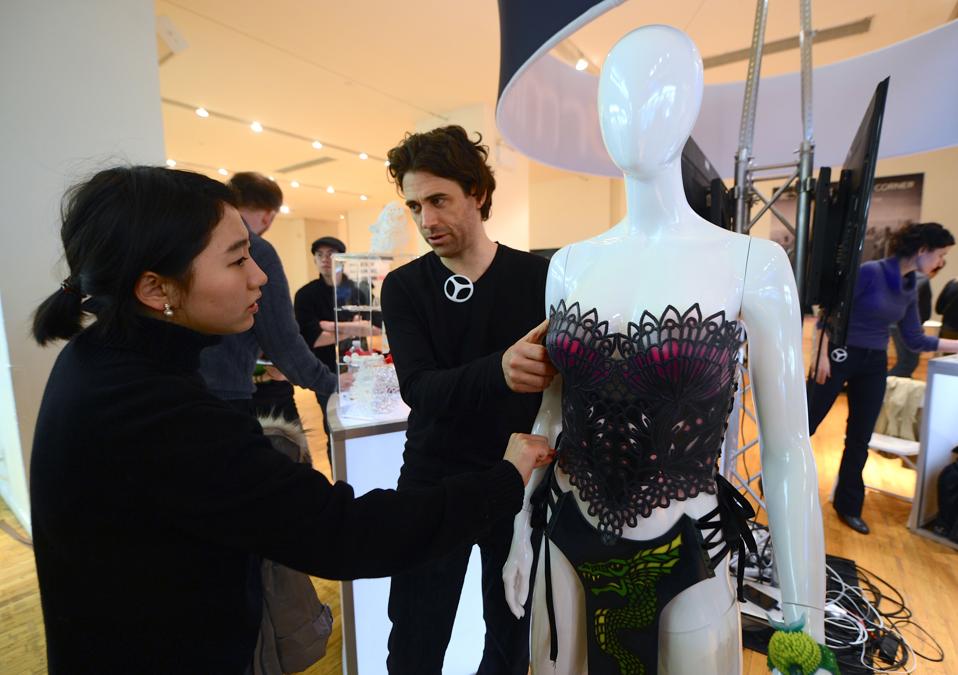
featured image3D printing has been described as nothing short of a new industrial revolution that holds potential for major innovation in terms of business models and consumption patterns. This technological development is part of the 4thindustrial revolution that is characterized by a range of new technologies fusing the physical, digital and biological worlds, impacting all industries including luxury fashion. 3D printing has been specifically helped by advances in material science, digital design and on-demand production capabilities. There are three main technologies behind 3D printing. The most common is FDM (Fused Deposition Modelling), where a nozzle deposits layers of melted filaments one after the other at a temperature of around 200 degrees Celsius. The science aside, is 3D printing a game changer that is disrupting luxury fashion the way e-commerce has disrupted retail businesses? What are the challenges it poses to the luxury business? What are its limitations? And how can the luxury business capitalize on its potential? Challenges to the luxury business Probably the biggest challenge that 3D printing poses to the luxury business is intellectual property (IP) infringement and counterfeiting. Luxury fashion greatly relies on IP to legally protect the creative ideas, designs and products of a designer or brand in the form of copyrights, trademarks or patents. Without IP protection, creativity and innovation would suffer, and there would be negligible brand value and customer loyalty. http://damnedgooddesign.com
With global imports of counterfeit goods already estimated to be worth $500 billion a year, it is likely 3D printing will only add to that figure. The growing threat of counterfeit 3D printing stems from the increasing availability of cheap 3D printers, printing materials and design specifications for items ranging from bags, apparel and jewellery. Countermeasures such as microchips in genuine items are possible solutions, but counterfeiting will remain a problem as long as there is market demand. 3D printing also challenges existing luxury retail models. With consumers able to play a more active role in the design and creation of their products, industry functions such as high-quality production chains, omni-channel retailing and that exclusive store experience have been called into question. Luxury brands risk losing significant market presence if these aspects of their business are curtailed.
Limitations of 3D printing 3D printing has not had a uniform impact on the luxury business. The technology is better suited to hard materials over soft ones, and geometrical over organic shapes. At present, 3D printing appears better suited for accessories such as jewellery, eyewear and watches. Even in the case of a high-end 3D printing jewellery studio like VOJD Studios in Berlin which works with the likes of Alexander McQueen and LOEWE, the finishing of 3D printed products entails precise manual work and traditional craftsmanship. As for 3D printing at home, as novel and convenient as it might be, there are limits when it comes to luxury products. In today’s experience economy, 3D printing cannot replicate the experience of buying a luxury product in a store along with the opportunity to be part of a brand’s philosophy or appreciate its fine craftsmanship. The evolution of materials for fabrics in 3D printing has been slow and there remains a trade-off between stiffness, robustness and comfort. Because the technology involves fusing layers of melted plastic one on top of another, a 3D printed fabric does not behave the way a woven textile adapts its shape to the body. At present, 3D printing for fabrics is unlikely to disrupt the luxury apparel segment, which is projected to grow from US$1.8 billion to $60.7 billion between 2015 and 2024.
Evolving fashion tapestry That does not mean 3D printing should be written off. One brand that has managed to buck the trend is Danit Peleg, an Israeli company that has gained a following for its wearable designs. In Asia, Malaysian designer Melina Looi’sinvolvement in Asia’s first 3D printed fashion show could be the start of a new wave of fashion that embraces the technology in this region. Rather than being blinded by the hype or dismissing it, luxury players should embrace 3D printing as part of an evolving fashion tapestry that allows them to innovate with new materials and designs, and create new concepts and processes to captivate sophisticated tastes. Luxury brands can harness 3D printing’s ability to customise products to appeal to the affluent customer who seeks to express her individuality. Industry players also envision a trend of hybridization where 3D printing technology is coupled with traditional methods to produce hybrid creations that reflect the best of both worlds. In the age of disruption, the gradual rather than sudden induction of 3D printing into the fashion tapestry affords luxury brands the opportunity to shape it in their own image.

Top stories: Two new letters for the genetic code, stat checking psychology, and the formerly abominable snowman

Scientists just added two functional letters to the genetic code All life forms on Earth use the same genetic alphabet of the bases A, T, C, and G—nitrogen-containing compounds that constitute the building blocks of DNA and spell out the instructions for making proteins. Now, scientists have developed the first bacterium to use extra letters, or unnatural bases, to build proteins. The traditional four DNA bases code for 20 amino acids, but the addition of new letters X and Y could produce up to 152 amino acids, which might become building blocks for new drugs and novel materials, the scientists say. http://commonwealthadvisorybureau.org/ China’s dark matter space probe detects tantalizing signal
A long-standing challenge in physics has been finding evidence for dark matter, the stuff presumed to make up a substantial chunk of the mass of the universe. Its existence seems to be responsible for the structure of the universe and the formation and evolution of galaxies. But physicists have yet to observe this mysterious material. Results reported Wednesday by a China-led space science mission provide a tantalizing hint—but not firm evidence—for dark matter. Controversial software is proving surprisingly accurate at spotting errors in psychology papers When Dutch researchers developed an open-source algorithm named statcheck to flag statistical errors in psychology papers, it received mixed reactions from the research community—especially after the free tool found that tens of thousands of published papers contained statistical inconsistencies. Some scientists have called these studies a “form of harassment,” and others have questioned the accuracy of the tool itself. Now, a new study by statcheck’s developers—posted to a preprint server this week—suggests their algorithm gets it right in more than 95% of cases. Expect that result to be checked. Ancient flying reptiles cared for their young, fossil trove suggests A spectacular fossil find is providing tantalizing new clues about the habits of pterosaurs, ancient flying reptiles that lived at the same times as dinosaurs. The cache of more than 200 fossil eggs found with bones of juvenile and adult animals in northwestern China suggests to some researchers that pterosaur parents may have cared for their newly hatched young. In a paper published Thursday in Science, researchers report that a 3-meter-square chunk of rock they excavated contains 16 eggs with the fossilized bones of developing embryos. So much for the abominable snowman. Study finds ‘yeti’ DNA belongs to bears Hikers in Tibet and the Himalayas need not fear the monstrous yeti—but they’d darn well better carry bear spray. Previous genetic analyses of a couple of “yeti” hair samples collected in India and Bhutan suggested that a stretch of their mitochondrial DNA resembled that of polar bears. That finding hinted that a previously unknown type of bear, possibly a hybrid between polar bears and brown bears, could be roaming the Himalayas. Now, DNA analyses of nine samples purported to be from the “abominable snowman” reveal that eight actually came from various species of bears native to the area.

10 Pairs of Celebrity Frenemies


Taylor Swift vs Katy Perry Diss Track! ►► More Celebrity News ►► Drama King: Nicki Minaj's Outrageous Video ►► Celebs who’ve Dissed Ariana Grande ►► And that, my friends, is one of the first mainstream documented uses of the word frenemy. Ya know. Friend + Enemy = Frenemy! And ever since Carrie Bradshaw uttered the clever amalgam of language, the word has not only become part of our cultural lexicon, but we’ve seen this kind of relationship pop up allll over the place – especially when it comes to celebrities. And even though we like to imagine celeb BFFs being inseparable and perfect, let’s not forget – they’re human too, so they’re bound to run into some friendships that will turn sour. Paris Hilton and Nicole Richie, Britney Spears and Christina Aguilera – we’ve been dealing with “frenemies” for quite some time. 1. Taylor Swift and Katy Perry 2. Demi Lovato and Selena Gomez 3. Demi Lovato and Taylor Swift 4. Victoria Justice and Ariana Grande 5. Ed Sheeran and Niall Horan 6. Ariana Grande and Jennette McCurdy 7. Ariana Grande and Miley Cyrus 8. Selena Gomes and the Jenners 9. Michael Clifford and Luke Hemmings 10. Lea Michelle and Naya Rivera For More Clevver Visit: Website: Like us on Facebook: Follow us on Twitter: Keep up with us on Instagram: Add us to your circles on Google+: Tweet Me:

The Empty Storefronts in New York City

featured image

Wishing for the halcyon days of yore when mom-and-pop shops dotted New York City doesn’t explain or address today’s retail realities.

Among the varied reasons to consider: Retail space inventory is rising, demand is falling and online purchases are undermining the economic viability of brick-and-mortar stores across America.

Local government has increased the burdens on retail stores: rising real property taxes, the New York commercial rent tax, living-wage requirements, paid sick leave and byzantine land use regulations.

It would be ironic, and legally dubious, to add to these costs by taxing vacant storefronts. The overwhelming majority of landlords would love a rent-paying tenant to occupy their retail space instead of leaving it vacant. It is the economically rational thing to do. http://commonpitchnyc.com

Market forces are adjusting and prices are falling. In fact, the Real Estate Board of New York’s latest retail report shows rents softening by 25 percent along the same Bleecker Street corridor cited by The Times.

Public and private sectors should face facts and work collaboratively to bolster the retail market.

Blaming landlords for high rents in New York City is a political judgment, not an economic one. At least half the rent being paid by anyone (either residential or commercial) is passed through directly by the landlord to the city for real estate taxes, water and sewer charges and miscellaneous fees.

In many instances, the rest of the rent is applied by the landlord to utility costs, fuel costs, insurance costs, and miscellaneous repairs and maintenance. It is a fortunate landlord who gets to retain more than 10 percent of the actual rent payment.

Before blaming “greedy” landlords “mightily for this blight,” remember that this is a complex issue that has become political fodder in a city where tenants have an overwhelming political majority.

A plague of empty storefronts disfigures villages, towns and cities from sea to shining sea. Predatory online pricing, not “online shopping,” is the primary source of this problem, as retail stores cannot afford to sell goods at cost or below.

Federal and state antitrust enforcement against predatory sellers would help preserve a healthy mix of brick-and-mortar retail stores.

The second serious problem, as you rightly point out, is the greed of landlords who force successful retailers out of sustainable spaces in search of richer tenants, who rarely turn up.

Reversing this trend will require a system of tax penalties, credits or rent regulation in coordination with state, county and city governments.

BRUCE JOSHUA MILLER, CHICAGO

The writer is a book publishers’ representative who sells to brick-and-mortar bookstores.

To the Editor:

Your editorial suggests several reasons for empty storefronts in New York City: rising rents, the growth of online shopping and the city’s onerous tax burden.

But you don’t mention another obvious culprit: the set of labor laws and other mandates that the city has imposed. A partial list includes a city-supported minimum-wage mandate, a paid-sick-leave mandate, a recently passed employee scheduling mandate, labeling requirements and many more.

Each time the city imposes these laws, business owners warn that these laws can harm businesses — mostly by raising costs above what shoppers can afford. Rarely does one law cause a business to go under. But the cumulative effect is a major reason there are so many empty storefronts.

As the owner of a closed restaurant put it, “We do the numbers, and they don’t work anymore.”

It is important to understand the devastating impact of these laws on otherwise viable businesses. Rolling them back is one way to enable entrepreneurs with very little in the bank to profitably run the businesses that once filled now-empty storefronts.

Sunday, 3 December 2017

Top 10 Hottest Pics Of Celebs In Yoga Pants


Top 10 Hottest Pics Of Celebs In Yoga Pants 10 Pics Of Celebs In Yoga Pants 1. Kaley Cuoco 2. Kelly Brook 3. Ronda Rousey & Carmen Electra 4. Rosie Huntington-Whiteley 5. Megan Fox 6. Gigi Hadid 7. Kendall Jenner 8. Candice Swanepoel 9. Sofia Vergara 10. Jennifer Lopez